


( 2026 ಭುರ್ಗ್ಯಾಂಚೆಂ ವರಸ್.)
St Lawrence Church & Shrine joyfully inaugurated the year 2026 as the “Year of Children” during the 8:30 a.m. Children’s Mass on 11th January 2026.
At the beginning of the Mass, children from each catechism class joined a solemn procession, carrying lamps, flowers, and symbols representing the 12 Fruits of the Holy Spirit. They were accompanied by the catechism teachers, Vice President Mr John D’Silva, Secretary Mr Alwyn Saldanha, all Commission Heads, Mrs Avitha Mascarenhas, and Sunday Catechism Coordinator Mrs Lavina Menezes.
Mrs Lavina Menezes introduced the significance of declaring 2026 as the Year of Children, highlighting the Church’s special focus on nurturing the faith, values, and spiritual growth of young minds.
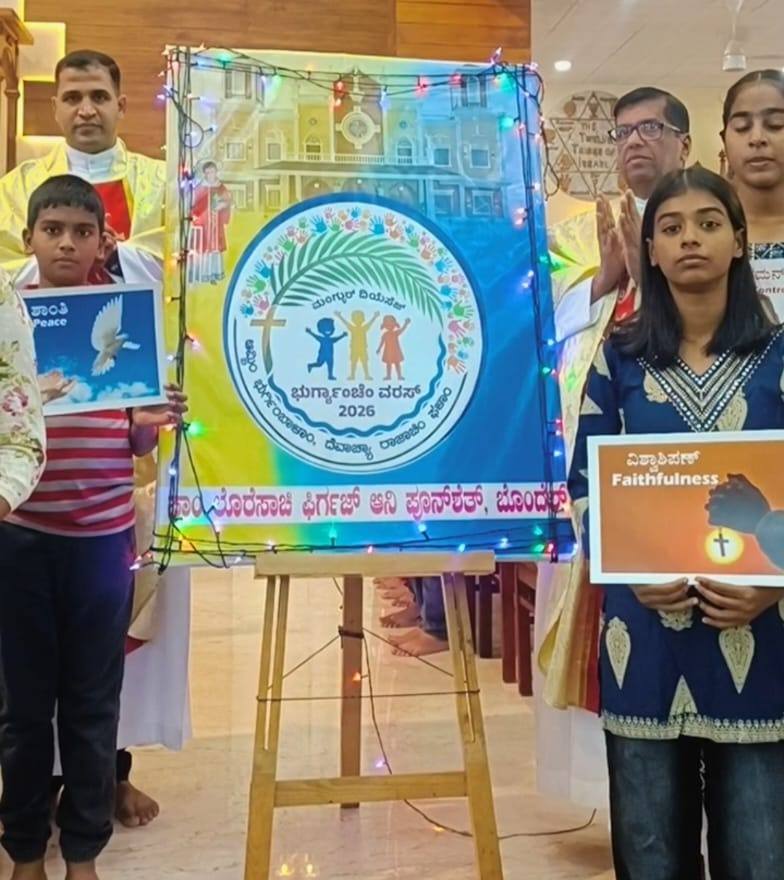
Rev. Fr Andrew Leo D’Souza, Parish Priest, prayed over all the children, unveiled the Year of Children 2026 logo, and extended his heartfelt wishes and blessings to them.
During the homily, Rev. Fr Lawrence Cutinha, Assistant Priest and Director of Sunday Catechism, explained the meaning and symbolism of the logo in a simple and engaging manner, helping both the children and the gathered faithful to understand its message and purpose.
Theme of the Year of Children
“Amchim Bhurgim Ballaam, Devachya Razachim Follam”
(“Our children are the fruits of God’s Kingdom”)
This initiative aims to nurture faith, values, and spiritual growth among children, encouraging them to grow closer to God and to actively participate in the life and mission of the Church.
Meaning of the Logo
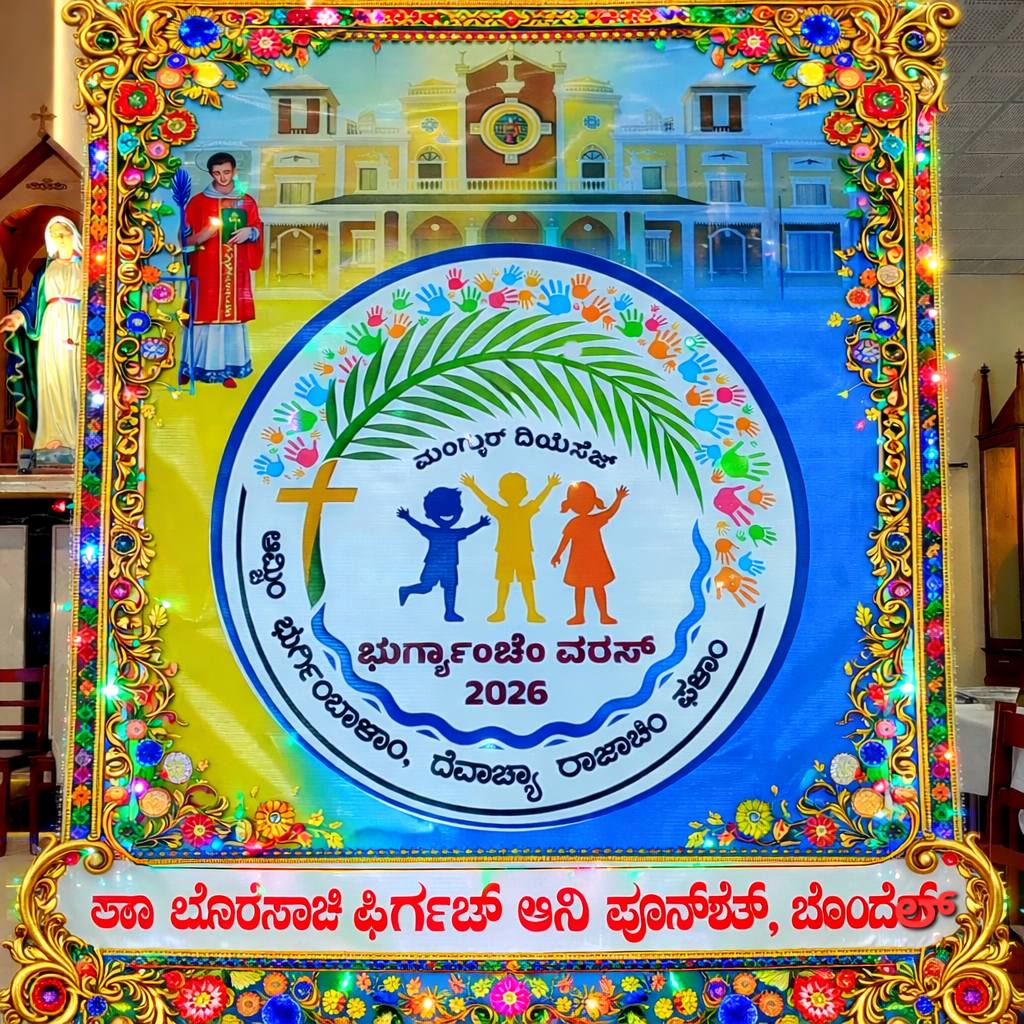
This logo has been designed to serve as the visual heartbeat of our diocesan mission in 2026. It bridges our local Mangalorean identity with the universal call of the Church, particularly aligning with the 2nd World Day of Children celebrated by the Holy Father.
Theme & Theological Foundation
“Let the little children come to me.” (Matthew 19:14)
The logo is rooted in the biblical mandate that children are not merely the “future” of the Church, but the “present”. It reflects a pastoral vision of accompaniment, protection, and joyful discipleship.
Symbolic Elements & Their Meaning
The Central Silhouettes: The Journey of Faith
At the heart of the logo are three children in mid-stride. This represents the energy, joy, and movement of the youngest disciples of Jesus. They are not static; they are walking forward. This visualises the Church’s mission to accompany children as they begin their lifelong journey with Christ.
The Palm-Cross: Sheltered by Grace
The Cross is uniquely integrated into a vibrant green palm leaf.
Local Identity: The palm is the iconic symbol of our coastal Diocese of Mangalore.
Divine Protection: The curve of the leaf acts as a canopy, signifying that God’s grace shelters our children as they grow within the life of the Church. It reminds the lay faithful, clergy and religious, along with parents, of their duty to provide a “shade” of safety and spiritual nourishment.
The Blue Waves: Victory over Troubled Waters
The wavy blue lines at the base serve a dual purpose:
The World’s Challenges: They symbolise the often-troubled waters of the modern world-secularism, digital dangers, and social pressure-that our children must navigate.
The Mantle of Grace: The blue also represents the mantle of Christ’s grace and the protection of Mother Mary. It signifies that with Christ as their “navigator,” our children can walk over these waters with confidence.
The Arch of Handprints: Celebrating Uniqueness
Surrounding the top of the logo is an arch of colourful handprints.
Individual Talents: Each handprint is different, celebrating the uniqueness and diverse talents of every child in our parishes.
Unity in Diversity: Together, they form a “rainbow of promise,” showing that while every child is a unique gift, they are all united under the one banner under the patronage of St Joseph, our patron.
The Circular Typography: The Path of Faith
The text flows in a circle, representing the eternity of God’s love and the cycle of faith passed from one generation to the next. The inclusion of our Konkani couplet— “ಆಮ್ಚಿಂ ಭುರ್ಗಿಂಬಾಳಾಂ, ದೆವಾಚ್ಯಾ ರಾಜಾಚಿo ಫಳಾಂ” (Amchim bhurgimballam, Devachya Razachim follam)—reminds us that our children are the “precious fruits of God’s Kingdom”.
The liturgy was prayerfully handled by the 8th Standard children, while the Children’s Choir added beauty and devotion to the celebration through their meaningful and melodious singing.
Before the final blessing, Rev. Fr Andrew Leo D’Souza extended his warm good wishes to all the children, praying that the Year of Children 2026 may be a year of joy, faith, and abundant blessings for every child.
Report: Meena Serrao Barboza


0 Comments